
Recent school safety guidance highlights the importance of preventing finger-trapping injuries
Finger-trapping injuries are a recognised risk in schools, particularly where young children use heavy doors, frequently accessed entrances and gates.
In April 2026, several of the local County Councils school health and safety teams issued a safety bulletin on finger guard protection, following a small number of incidents.
The guidance reminds schools of the importance of identifying potential finger-trapping hazards and installing suitable protection where needed.
For schools across Hampshire, Surrey and Berkshire, it provides a useful reminder that even everyday features such as doors and gates should be considered as part of routine premises safety.
Where Are Children Most at Risk of Trapping Their Fingers?
Finger-trapping injuries can occur when a child's hand becomes caught between a moving door or gate and its frame.
The hinge side can be particularly hazardous because the gap narrows as the door closes.
Areas that schools may wish to review include:
Classroom and corridor doors
Toilet entrance and cubicle doors
Cloakroom doors
Main entrance doors
Playground and pedestrian gates
Heavy or self-closing doors
The risk can be greater where younger children use doors without direct supervision.
How Can Finger Guards Help?
Finger guards are protective devices designed to reduce access to hazardous gaps around door and gate hinges.
Depending on the installation, they may cover the hinge area or prevent fingers from entering a narrowing gap.
However, finger guards are only one part of effective door and gate safety.
Schools should also consider the condition of hinges, closing mechanisms, gate movement, existing safety devices and how each entrance is used.
Where protective devices have already been installed, regular inspection is important to identify damage, deterioration or missing components.
School Gate Safety Should Not Be Overlooked
External gates can present similar hazards to internal doors.
Manual and automated gates may create trapping or crushing points around hinges, posts and moving components.
The Health and Safety Executive advises that powered gate safety must consider foreseeable use, including the presence of children, and that systems should be appropriately designed and maintained.
Schools should therefore review their gates as well as their internal doors when assessing potential hazards.
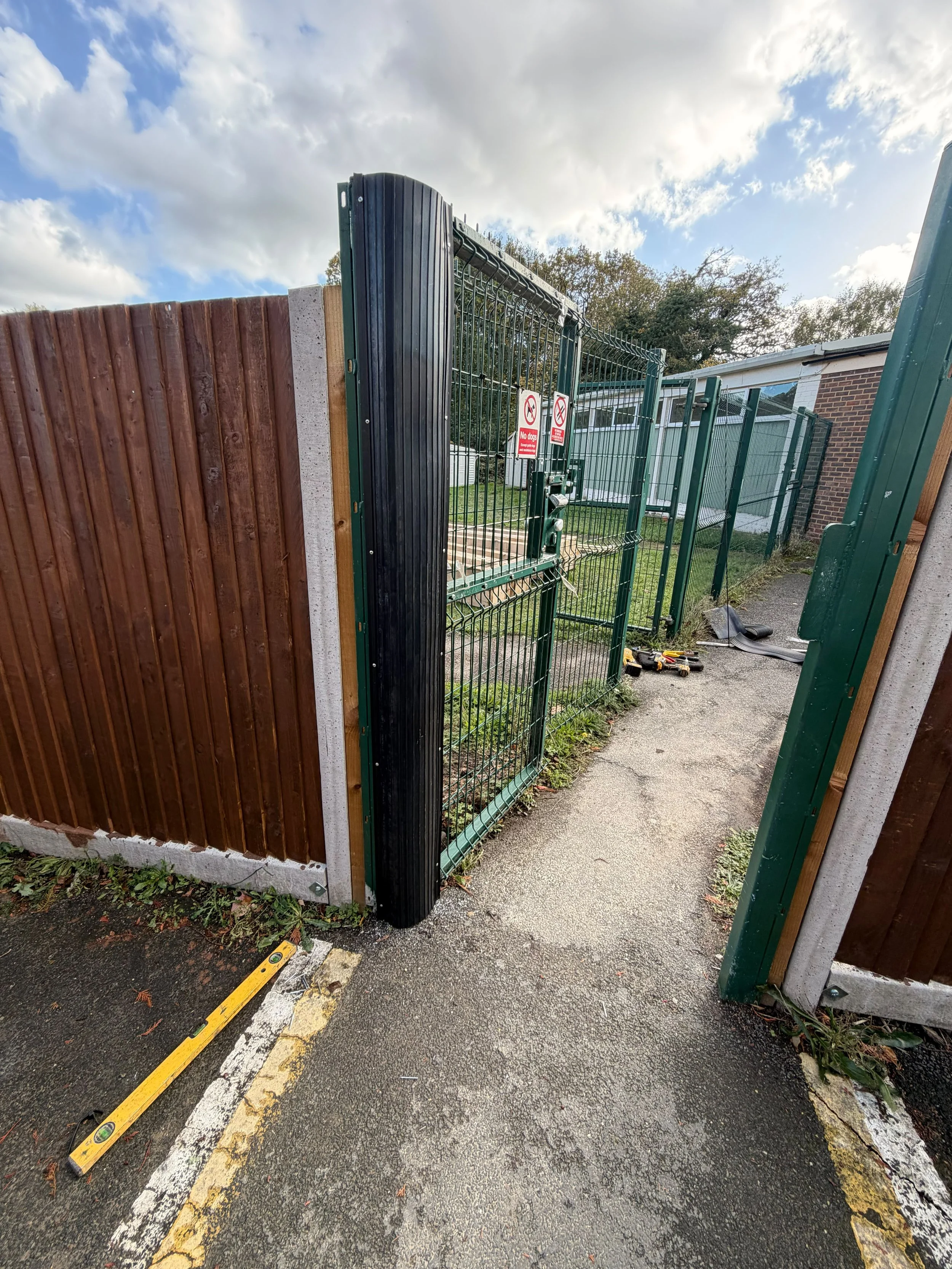
A Recent Finger Guard Installation in Surrey
Sleeptight Security recently completed a finger guard installation at a school in Addlestone, Surrey.
The project involved fitting protective guards to school gates and doors to help reduce the risk of fingers becoming trapped during everyday use.
The installation demonstrates how relatively straightforward safety improvements can contribute to a safer environment for pupils, staff and visitors.
Read our School Gate Finger Guard Installation case study in Addlestone, Surrey.
Reviewing Door and Gate Safety at Your School
School premises change over time. Doors experience frequent use, hinges and closing mechanisms wear, and protective equipment can become damaged.
Regular safety reviews can help schools identify areas requiring attention before an incident occurs.
If your school is reviewing door and gate safety, Sleeptight Security can discuss suitable finger protection solutions and related gate safety improvements.